What your TSH level means
TSH is the first number doctors look at to check your thyroid — and it works backwards from how most people expect. Here's what TSH measures, the typical ranges, what high and low values mean, and why one reading is rarely the whole story.
Quick reference: for the typical range at a glance, see TSH in our blood test results library, or explore the complete blood test results index.
This is general educational information, not medical advice. Thyroid results need interpretation by a clinician, often alongside other thyroid tests.
What TSH measures
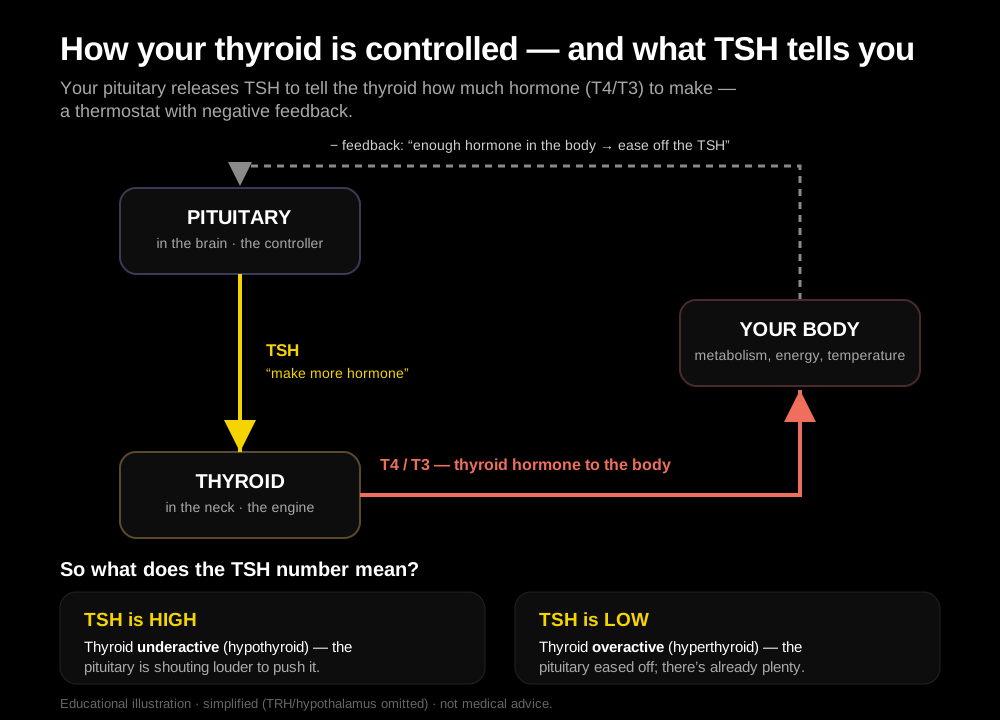
TSH (thyroid-stimulating hormone) isn't made by your thyroid — it's made by your pituitary gland, which uses it to tell the thyroid how much hormone (T4 and T3) to produce. It's a feedback loop, which is why TSH reads "backwards":
- If your thyroid is underactive, the pituitary pumps out more TSH to push it → high TSH.
- If your thyroid is overactive, the pituitary backs off → low TSH.
Because the pituitary is so sensitive to thyroid hormone, TSH is the best single first-line test. The thyroid, a small butterfly-shaped gland at the front of your neck, sets the pace of your metabolism — how you use energy, regulate temperature, and keep your heart, gut, and mood ticking along. TSH is the thermostat's dial, not the temperature itself, which is exactly why the number can feel counterintuitive.
Typical reference range
A common reference range is roughly 0.4–4.0 mIU/L, but labs differ and "optimal" can vary — pregnancy, age, and specific conditions shift the target. Always read against your lab's range.
At a glance:
| Your TSH | Thyroid state | Often means |
|---|---|---|
| Below ~0.4 mIU/L | Overactive | Hyperthyroidism |
| ~0.4–4.0 mIU/L | Normal | — |
| Above ~4.0 mIU/L | Underactive | Hypothyroidism (mildly raised = subclinical) |
What high TSH means
High TSH usually points to an underactive thyroid (hypothyroidism). When the thyroid can't keep up, the pituitary raises its signal — so a high TSH is the body working harder to squeeze out enough hormone. Common symptoms tend to be the "slowed-down" ones:
- Fatigue and low energy
- Weight gain or difficulty losing weight
- Feeling cold when others are comfortable
- Dry skin and hair, brittle nails
- Constipation
- Low mood, brain fog, or trouble concentrating
- Heavier or irregular periods
Symptoms are often gradual and easy to write off, which is part of why a lab number can surface something you'd half-noticed for months. A mildly raised TSH with normal thyroid hormone is called subclinical hypothyroidism (more on that below). The most common cause of an underactive thyroid overall is Hashimoto's thyroiditis, an autoimmune condition — which is where thyroid antibody testing comes in.
What low TSH means
Low TSH usually points to an overactive thyroid (hyperthyroidism). There's plenty of thyroid hormone circulating, so the pituitary dials its signal down. Symptoms tend to be the "sped-up" ones:
- Unintended weight loss despite normal or increased appetite
- Racing heart, palpitations, or irregular heartbeat
- Anxiety, irritability, or restlessness
- Tremor (often a fine shake in the hands)
- Feeling hot and sweating easily
- Trouble sleeping
- More frequent bowel movements
A low TSH always needs follow-up testing to find the cause. Common causes include Graves' disease (the autoimmune counterpart to Hashimoto's), an overactive nodule, or thyroiditis. Occasionally a low TSH reflects too high a dose of thyroid medication rather than disease. Sustained, untreated hyperthyroidism can strain the heart and bones over time, so it's not something to sit on.
Subclinical thyroid disease: when TSH is off but hormones are normal
The word "subclinical" describes the in-between state where TSH is abnormal but the actual thyroid hormones (free T4, and often free T3) are still in range. It's common and often causes no symptoms.
- Subclinical hypothyroidism — raised TSH (frequently ~4.5–10 mIU/L) with normal free T4. Many people in this range are simply monitored with repeat testing, because a single mildly high TSH can be transient (a passing illness, recent stress, or normal fluctuation) and may return to normal on its own. Whether treatment is offered often depends on how high the TSH is, symptoms, thyroid antibodies, age, and whether you're pregnant or trying to conceive.
- Subclinical hyperthyroidism — low TSH with normal free T4 and free T3. This is likewise often monitored, with attention to heart rhythm and bone health in some groups.
The practical takeaway: a borderline TSH is usually a reason to look closer and re-test, not to panic. What your clinician does next depends on the whole picture, not the one number — which is exactly why the trend and the accompanying tests matter.
How free T4, free T3, and TPO antibodies complete the picture
TSH is the signal. To understand what the thyroid is actually doing, clinicians add the hormones themselves and, when relevant, antibody tests:
- Free T4 (thyroxine) — the main hormone the thyroid releases. Pairing it with TSH separates overt disease from subclinical patterns and helps flag unusual cases (for example, a low TSH and low free T4 can point to a pituitary problem rather than the thyroid).
- Free T3 (triiodothyronine) — the more active hormone, converted from T4 in the tissues. It's especially useful in suspected hyperthyroidism, where T3 can rise before T4.
- TPO antibodies (thyroid peroxidase antibodies) — a marker of autoimmune thyroid disease. Positive TPO antibodies alongside a raised TSH point toward Hashimoto's and can raise the likelihood that a borderline TSH progresses over the years. In suspected Graves' disease, a different antibody (TSH-receptor antibody) is used.
You don't need every test every time. TSH alone is a reasonable screen for many people; the extra markers earn their place when TSH is abnormal, symptoms don't fit, or an autoimmune or pregnancy question is in play. This is also why thyroid results reward interpretation over self-diagnosis — the same TSH number can mean different things depending on what the hormones and antibodies show. For a broader tour of common panels, see how to read your blood test results and what HDL, LDL, TSH and CBC mean.
Why targets and reference ranges vary
There's no single "correct" TSH for everyone, and the printed range on your report is a starting point, not a verdict:
- Age. TSH tends to drift slightly higher with older age, and some evidence suggests a mildly raised TSH in older adults may not carry the same meaning as in a younger person. Clinicians weigh this before treating a borderline result.
- Pregnancy. Thyroid demands change substantially, and targets are generally lower and trimester-specific. Ordinary adult ranges don't apply (see below).
- Lab and assay differences. Different labs use different equipment and cutoffs, so a value that's "high" at one lab may be in range at another. This is one reason it helps to compare results measured the same way over time.
- Individual set-point. Each person has a fairly stable personal baseline within the population range. A value that's normal for the population could still be a real change for you — which only shows up when you can see your own history.
TSH and pregnancy
Pregnancy deserves its own note because the rules genuinely change. The thyroid works harder to support a pregnancy, the target TSH range is generally lower and specific to each trimester, and both under- and over-active thyroid function can matter for parent and baby. Practical points, all to be handled with your medical or maternity team:
- If you have a known thyroid condition and become pregnant, testing is usually done early and repeated, and medication doses often need adjusting.
- If you're planning pregnancy, it's reasonable to ask whether your thyroid should be checked or optimized beforehand.
- Don't self-interpret a pregnancy TSH against a standard adult range — it can be misleading in both directions.
This is educational information only; pregnancy thyroid care should always be individualized by a clinician.
Medications, supplements, and biotin interference
A few common things can move your TSH or distort the test itself — worth knowing before you read too much into a single result:
- Thyroid medication (e.g. levothyroxine). If you're on treatment, TSH is the number your clinician uses to fine-tune the dose, and it can take six weeks or more after a dose change to settle. Timing and consistency of the dose relative to the blood draw matter.
- Biotin. High-dose biotin — common in hair, skin, and nail supplements — can interfere with certain lab immunoassays and produce falsely high or low thyroid readings. Many labs advise pausing biotin for a couple of days before testing; follow your lab's specific guidance.
- Other medicines. Some drugs (for example, certain steroids, amiodarone, lithium, and biologics used in cancer care) can affect thyroid function or the test. Tell your clinician what you take rather than adjusting anything yourself.
- Recent illness. Acute illness can transiently shift TSH, so a result taken while you're unwell may not reflect your true baseline.
Never start, stop, or change a medication or supplement based on a self-read lab value — that's a conversation for your clinician.
Why tracking matters
Thyroid status can drift over months and years, and TSH naturally fluctuates, so the trend across tests is more telling than a single borderline value — especially if you're on thyroid medication and dialing in a dose, or watching a subclinical result to see whether it settles or progresses. Because reference ranges and your own set-point both play a role, a series of results measured over time is far more informative than any one snapshot. Seeing TSH plotted over time, next to symptoms and your other labs, is the connected view that scattered reports can't give you. See what HDL, LDL, TSH and CBC mean and tracking lab results over time.
What typically happens after an abnormal result
An out-of-range TSH is a starting point, not a diagnosis. A common path looks like this — though your clinician tailors it to you:
- Repeat the test. A single abnormal TSH is often re-checked after a few weeks, sometimes with free T4 added, to confirm it's real and not a passing fluctuation.
- Add hormones and antibodies. Free T4, sometimes free T3, and TPO antibodies help pin down whether it's overt or subclinical, and whether an autoimmune cause is likely.
- Review symptoms, history, and medications. Your clinician weighs the numbers against how you feel, your age, pregnancy status, family history, and anything you're taking (including biotin).
- Decide: monitor or treat. Many borderline results are simply monitored with periodic testing. Clear or symptomatic disease may lead to treatment and follow-up testing to confirm it's working.
Throughout, the number rarely acts alone — which is the running theme of thyroid testing.
When to talk to a doctor
Any TSH outside your lab's range — or thyroid-type symptoms with a borderline value — is worth raising with a clinician, who may add free T4/T3 or antibody tests. Get medical advice sooner rather than later if you have marked symptoms (for example a fast or irregular heartbeat, significant unintended weight change, or a swelling in the neck), if you're pregnant or planning pregnancy, or if you're already on thyroid medication and something feels off. Thyroid results are among the clearest examples of a lab value that needs a person, not just a range, to interpret. For more on reading your panels, see understanding your CBC results, what your vitamin B12 level means, or browse the rest of the Quanome blog.
Track your TSH over time, privately
Quanome pulls your lab results into one private timeline and tracks them over time — on your device, never uploaded. Learn more about Quanome →
Try the iOS beta →Frequently asked questions
What does TSH measure?
TSH (thyroid-stimulating hormone) is the signal your pituitary sends to tell your thyroid how much hormone to make. It's the most sensitive first-line test of thyroid function — counterintuitively, high TSH usually means an underactive thyroid, and low TSH an overactive one.
What is a normal TSH level?
A common reference range is roughly 0.4–4.0 mIU/L, though labs vary and optimal targets can differ by age and pregnancy. Read your value against your lab's printed range.
What does high TSH mean?
High TSH usually means an underactive thyroid (hypothyroidism) — the pituitary is shouting louder because the thyroid isn't keeping up. Symptoms can include fatigue, weight gain, cold intolerance, and low mood.
What does low TSH mean?
Low TSH usually means an overactive thyroid (hyperthyroidism) — there's plenty of thyroid hormone, so the pituitary dials its signal down. Symptoms can include weight loss, palpitations, anxiety, and heat intolerance.
What TSH number counts as high or low?
Against a typical 0.4–4.0 mIU/L range, above about 4.0–4.5 mIU/L is considered high (underactive/hypothyroid) and below about 0.4 is low (overactive/hyperthyroid). A high TSH with still-normal thyroid hormone (T4) is 'subclinical' hypothyroidism — often in the ~4.5–10 mIU/L range and frequently just monitored rather than treated.
What are free T4 and free T3, and why add them?
TSH is the pituitary's signal; free T4 and free T3 are the actual thyroid hormones circulating in your blood. Adding them shows whether the thyroid is keeping up with the signal, which is how clinicians tell overt disease from the milder 'subclinical' picture and pin down unusual patterns.
What are TPO (thyroid) antibodies?
Thyroid peroxidase (TPO) antibodies are a marker of autoimmune thyroid disease, most commonly Hashimoto's thyroiditis. Positive antibodies alongside a raised TSH point to an autoimmune cause and can raise the chance that a borderline TSH progresses over time. Interpretation belongs with a clinician.
Can biotin supplements affect my TSH result?
Yes. High-dose biotin (often found in hair, skin, and nail supplements) can interfere with some lab immunoassays and produce falsely low or high thyroid readings. Many labs advise pausing biotin for a couple of days before testing — ask your clinician or lab for their specific guidance.
Does pregnancy change the TSH target?
Yes. Thyroid demands shift in pregnancy and the target range is generally lower and trimester-specific, so ordinary adult ranges don't apply. Anyone pregnant, planning pregnancy, or newly pregnant with a thyroid history should have thyroid testing interpreted by their maternity or medical team.
The Quanome iOS beta is live
Make sense of your DNA and health data privately — try Quanome free on TestFlight now (Android coming later).
Try the iOS beta →Free TestFlight beta for iPhone. Not on iOS? Leave your email and we'll keep you posted (and ping you when Android lands).