What a high CRP means
CRP is your body's general "inflammation is happening" signal — useful, but easy to over-read. Here's what C-reactive protein and the high-sensitivity version (hs-CRP) measure, the ranges, what a high value does and doesn't tell you, the common causes, how it's read alongside other markers, and why context and trend matter.
Quick reference: for the typical range at a glance, see CRP in our blood test results library, or browse every lab marker in one place.
This is general educational information, not medical advice. A high CRP needs interpretation by a clinician alongside your symptoms and other tests.
What CRP measures
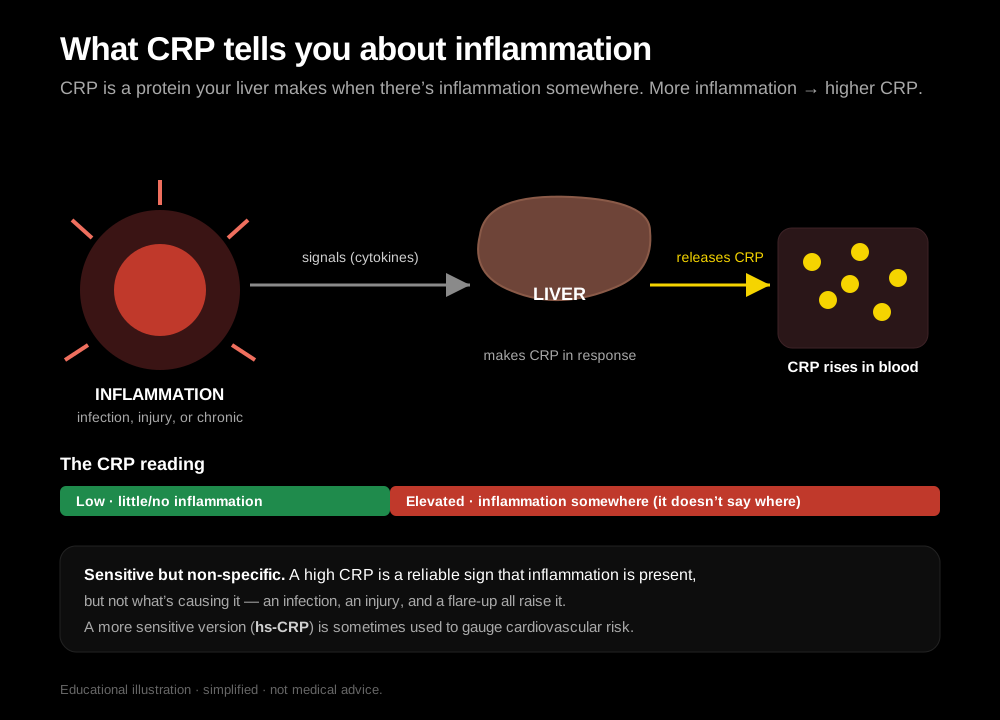
CRP (C-reactive protein) is made by your liver and rises in response to inflammation — whether from infection, injury, surgery, or a chronic inflammatory condition. It's nonspecific: it tells you inflammation is present, but not its location or cause.
The liver ramps up CRP production in response to signalling molecules (cytokines) released when the immune system is activated. Because that response is fast — measurable within hours and peaking within a day or two — CRP is a useful "is something inflamed right now?" readout. But that same speed and generality is its limitation: almost anything that inflames tissue can move it, so a raised value points you toward a question, not an answer.
There are two versions of the test:
- Standard CRP — for detecting active infection or inflammatory flares. On a lab report it's often labelled "CRP, Quantitative" (the result given as a number in mg/L).
- hs-CRP (high-sensitivity) — a more sensitive method used to assess long-term cardiovascular risk, where small differences matter.
Typical ranges
Standard CRP:
- Under ~3 mg/L — normal
- Above ~3 mg/L — active inflammation or infection
- Very high (e.g. tens of mg/L) — significant infection/inflammation
hs-CRP (cardiovascular risk):
- Under 1 mg/L — lower risk
- 1–3 mg/L — average risk
- Above 3 mg/L — higher risk
Labs vary — read against your report.
What specific CRP numbers mean
People often arrive with one figure in mind — a CRP of 10, or 50, or over 100. The table below (standard CRP, mg/L) is a rough guide to how far the value sits above the range, not a diagnosis — the size of the rise is a clue to the likely cause, but your symptoms and the trend carry the meaning.
| CRP (mg/L) | How it's usually read |
|---|---|
| Under 3 | Normal (standard CRP). For heart-risk hs-CRP: under 1 lower, 1–3 average |
| 3–10 | Mildly raised — low-grade or chronic inflammation, or the tail of a minor illness |
| 10–50 | Moderately high — active inflammation; often a viral or mild-to-moderate infection |
| 50–100 | Markedly high — points toward a significant infection or inflammatory process |
| Above 100 | Very high — usually a significant bacterial infection or major inflammation; followed up promptly |
The key caveat: a CRP of 10 the week after a cold means something very different from a CRP of 10 that stays put across repeat tests. The magnitude is a first clue; the cause and trend decide what it means.
What a high CRP means
A high CRP means inflammation somewhere — that's the key limit. Because it's nonspecific, a single high CRP is a prompt to look further, not a diagnosis. A transient spike from a cold is very different from a persistently elevated hs-CRP. Since metabolic stress can nudge CRP up, it often travels with other markers worth checking together — for instance what high liver enzymes mean, since fatty liver is closely tied to the same metabolic picture.
The common causes of a raised CRP
Because CRP responds to inflammation of almost any kind, the list of things that can raise it is long. Broadly, they fall into a few groups:
- Infections. These are the most frequent reason for a sharp rise. A bacterial infection often produces a larger jump than a viral one, but both can move the number. Everyday illnesses — a chest infection, a urinary infection, a bad cold — are common culprits.
- Injury, surgery, and intense exercise. Any tissue damage triggers an inflammatory response. CRP predictably rises after an operation and settles as you heal; a hard endurance session or an acute injury can nudge it up briefly too.
- Chronic inflammatory and autoimmune conditions. Rheumatoid arthritis, inflammatory bowel disease, lupus, vasculitis, and similar conditions keep the inflammatory system switched on, so CRP can be raised during flares and is sometimes used to help track disease activity over time.
- Obesity and metabolic stress. Excess body fat — especially around the abdomen — is metabolically active and produces low-grade inflammation, which typically shows up as a mildly elevated hs-CRP rather than a dramatic spike. This is the pattern most relevant to long-term cardiovascular risk.
- Smoking. Tobacco smoke is a chronic inflammatory stimulus and is associated with higher baseline CRP; levels tend to drift down after quitting.
Less common contributors include some medications and hormonal factors, certain cancers, and — at the other extreme — periods of severe, widespread inflammation. The point isn't to self-diagnose from the list, but to see why a clinician needs your symptoms and history to make sense of the number.
Markedly high vs mildly raised
How high the value is carries information about what's likely driving it.
- Mildly raised (roughly 3–10 mg/L). This range often reflects low-grade or chronic inflammation — the kind linked to metabolic health, excess weight, smoking, or a smouldering inflammatory condition. It can also simply be the tail end of a recent minor illness. It usually calls for context and a repeat test rather than urgent action.
- Moderately to markedly high (tens to hundreds of mg/L). Larger values more often point to a significant infection or a substantial inflammatory process, and typically prompt fairly prompt investigation to find and treat the source.
These are general patterns, not hard rules — a very fit person and someone acutely unwell can occasionally land at surprising numbers — but the magnitude of the rise is one of the first things a clinician weighs.
How CRP is read alongside other markers
CRP is rarely interpreted alone. On its own it says "inflammation, somewhere"; combined with other results it starts to point in a direction.
- With hs-CRP for heart risk, it sits beside cholesterol (LDL, HDL), blood pressure, blood sugar or HbA1c, and your family history — refining an overall cardiovascular risk estimate rather than standing in for it.
- With a full blood count, a raised white cell count alongside a high CRP can strengthen the suspicion of infection.
- With other inflammatory markers such as ESR (erythrocyte sedimentation rate), which rises and falls more slowly than CRP; the two together can help distinguish acute from more sustained inflammation.
- With metabolic markers such as liver enzymes and blood glucose, when the picture suggests metabolic rather than infective inflammation.
This is why "read against your whole panel" is not a throwaway line. A slightly high hs-CRP means something quite different in someone with otherwise healthy numbers than in someone with several metabolic markers drifting the same way.
What typically happens after a high result
There's no single pathway, but a common, sensible sequence looks like this:
- Context first. Were you unwell, injured, or recently operated on around the time of the test? An obvious explanation often makes the result unsurprising.
- Repeat when well. Because CRP moves fast, a raised value is frequently rechecked once any acute illness has passed, to see whether it settles.
- Look wider if it persists. A value that stays up across repeat tests, or a markedly high result with no obvious cause, usually leads to further tests guided by your symptoms — targeting the likely source rather than testing at random.
- Treat the cause, not the number. The aim is to identify and address whatever is driving the inflammation. CRP is a signal to follow, not a target to game.
Why the trend matters
CRP changes fast, so a one-off reading can simply catch you mid-cold. The trend is where the value is: a persistently elevated hs-CRP is a different story than a single spike that resolves. Watching it over time, alongside other markers, separates "I had a virus that week" from "something is chronically inflamed." See how to read your blood test results and tracking lab results over time.
Lifestyle factors and chronic low-grade inflammation
The mildly raised hs-CRP that matters for long-term health is often the kind that responds, slowly, to everyday habits. This is different from an infection-driven spike — here the goal is to lower the background level of inflammation over months, not to react to a single number. The factors with the most consistent links are unsurprising, because they overlap heavily with heart health:
- Not smoking. Quitting is one of the more reliable ways to bring a chronically raised CRP down over time.
- Regular physical activity. Consistent movement is associated with lower hs-CRP, though a single very hard session can raise it briefly — another reason not to test right after intense exercise.
- Body composition. Because abdominal fat is a source of inflammatory signalling, reaching a healthier weight tends to lower hs-CRP.
- Diet. Eating patterns built around whole foods, vegetables, fibre, and healthy fats are associated with lower inflammatory markers, while diets heavy in refined carbohydrates and ultra-processed foods trend the other way.
- Sleep and stress. Chronically poor sleep and sustained stress are both linked to higher inflammation; steady sleep and stress management are plausible, low-risk contributors to a lower baseline.
None of these are quick fixes, and none replace treating an underlying condition. But for someone whose hs-CRP is mildly up as part of a metabolic picture, they're the same changes a clinician would recommend for the heart anyway — which is part of why the marker is useful.
When to talk to a doctor
A high CRP — especially a markedly high one, or a persistently raised hs-CRP — should be interpreted by a clinician in the context of your symptoms and history. Seek prompt medical advice if a raised CRP comes with fever, significant pain, breathlessness, or feeling acutely unwell, since those point toward an active process that needs attention rather than watchful waiting. For more on understanding your panels, browse the rest of the Quanome blog.
Track your CRP over time, privately
Quanome pulls your lab results into one private timeline and tracks them over time — on your device, never uploaded. Learn more about Quanome →
Try the iOS beta →Frequently asked questions
What does CRP measure?
CRP (C-reactive protein) is a marker of inflammation made by your liver. It rises quickly in response to infection, injury, or other inflammatory conditions, so it's used as a general signal that inflammation is present somewhere in the body.
What is a normal CRP level?
Standard CRP is usually under 3 mg/L, with values above that suggesting active inflammation or infection. The high-sensitivity version (hs-CRP), used for cardiovascular risk, is read as under 1 mg/L (lower risk), 1–3 (average), and above 3 (higher risk).
What does a high CRP mean?
A high CRP means inflammation, but not where or why. Common causes range from a passing infection to injury, chronic inflammatory conditions, or obesity. A very high value usually points to significant infection or inflammation needing medical attention.
What is the difference between CRP and hs-CRP?
They measure the same protein; hs-CRP just uses a more sensitive method to detect the low levels relevant to long-term cardiovascular risk. Standard CRP is used for detecting active infection or flares.
Is 'CRP, Quantitative' the same as hs-CRP?
Not quite. 'CRP, Quantitative' usually refers to the standard CRP test reported as a number in mg/L, used to detect active infection or inflammation. hs-CRP uses a more sensitive method aimed at the low values that matter for long-term cardiovascular risk. Both measure the same C-reactive protein.
How high is 'too high' for CRP?
There's no single cutoff, but the size of the rise is a clue to the cause. Mildly raised values (roughly 3–10 mg/L) often reflect low-grade or chronic inflammation, while markedly high values — tens or hundreds of mg/L — more often point to significant infection or a major inflammatory process, and are usually followed up urgently. A clinician reads the number against your symptoms, not in isolation.
Is a CRP of 10, 20, or 50 high?
All three are above the usual normal range (under ~3 mg/L for standard CRP), so they count as raised. A CRP around 10 is mildly-to-moderately high and often reflects a passing infection, a recent injury, or low-grade inflammation. Values in the tens (20–50) suggest a more active inflammatory process, and above roughly 50–100 more often points to a significant infection. But the number alone isn't a diagnosis — a value of 10 just after a cold is very different from a persistent 10, and a clinician reads it against your symptoms and the trend.
Can a high CRP be caused by something harmless?
Often, yes. A common cold, a recent hard workout, a minor injury, dental inflammation, or even ordinary recovery after surgery can all raise CRP temporarily. That's why a single elevated result is usually rechecked once you're well, rather than treated as a diagnosis on its own.
Does hs-CRP tell me I'll have a heart attack?
No. hs-CRP is one input into cardiovascular risk, not a prediction. It's used alongside cholesterol, blood pressure, blood sugar, family history, and lifestyle to refine an overall risk estimate — and it's most useful as a trend rather than a single reading.
How long does it take for a raised CRP to come back down?
CRP responds quickly in both directions — it can rise within hours of an inflammatory trigger and typically falls back over days once the trigger resolves. A value that stays elevated across repeat tests weeks apart is more meaningful than a one-off spike, and is usually what prompts further investigation.
Should I try to lower my CRP with diet and lifestyle?
For chronic low-grade elevation tied to metabolic health, the same habits that help the heart — not smoking, regular movement, a mostly whole-food diet, good sleep, and reaching a healthier weight — tend to lower hs-CRP over time. But if CRP is high because of an infection or an inflammatory condition, the priority is diagnosing and treating that cause, not chasing the number. Discuss any plan with your clinician.
The Quanome iOS beta is live
Make sense of your DNA and health data privately — try Quanome free on TestFlight now (Android coming later).
Try the iOS beta →Free TestFlight beta for iPhone. Not on iOS? Leave your email and we'll keep you posted (and ping you when Android lands).